Audio Upscaler
Old rips, phone recordings and streamed audio stop dead at 4 or 8 kHz. This rebuilds what is missing above that line and writes 48 kHz, using UniverSR, a flow matching model that works in the complex STFT domain with no vocoder.
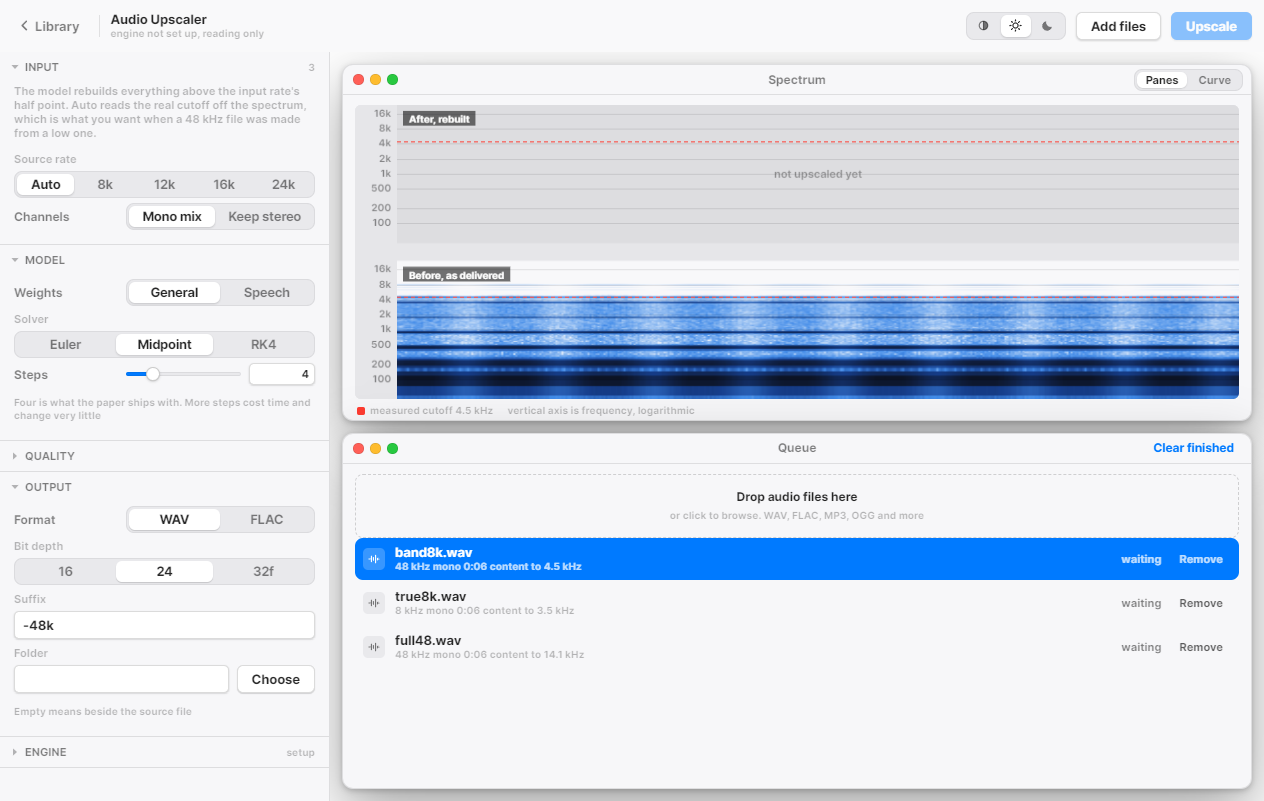
Everything else in this library runs in the browser tab. This one cannot. UniverSR is a 229 MB PyTorch model that wants a CUDA card, so it runs as a real Windows program with the same interface instead. The trade is the same one the rest of the library makes: your files stay on your machine.
Finds the real cutoff for you
A 48 kHz file that came from an 8 kHz source is still an 8 kHz file. The app measures the actual spectral cutoff and picks the input rate to match, rather than trusting the header. You can override it.
Shows the before and after
A spectrogram pair, or an average level curve, with the measured cutoff marked. Play A against B on any finished file.
Handles long files and small cards
Audio is processed in overlapping chunks and crossfaded back together, so length is not limited by video memory. If the card runs out, the chunk halves and that file restarts.
Queues, and keeps stereo if you want
Drop in a batch. Mono mix is the fast path, or run the model once per channel to keep the stereo image. Writes WAV or FLAC at 16, 24 or 32 bit float, and at 48, 96 or 192 kHz.
Exposes the knobs that matter
Weights for general audio or speech, the ODE solver and step count, and classifier free guidance. The paper suggests 1.0 to 1.5 for speech, 1.5 to 2.0 for music.
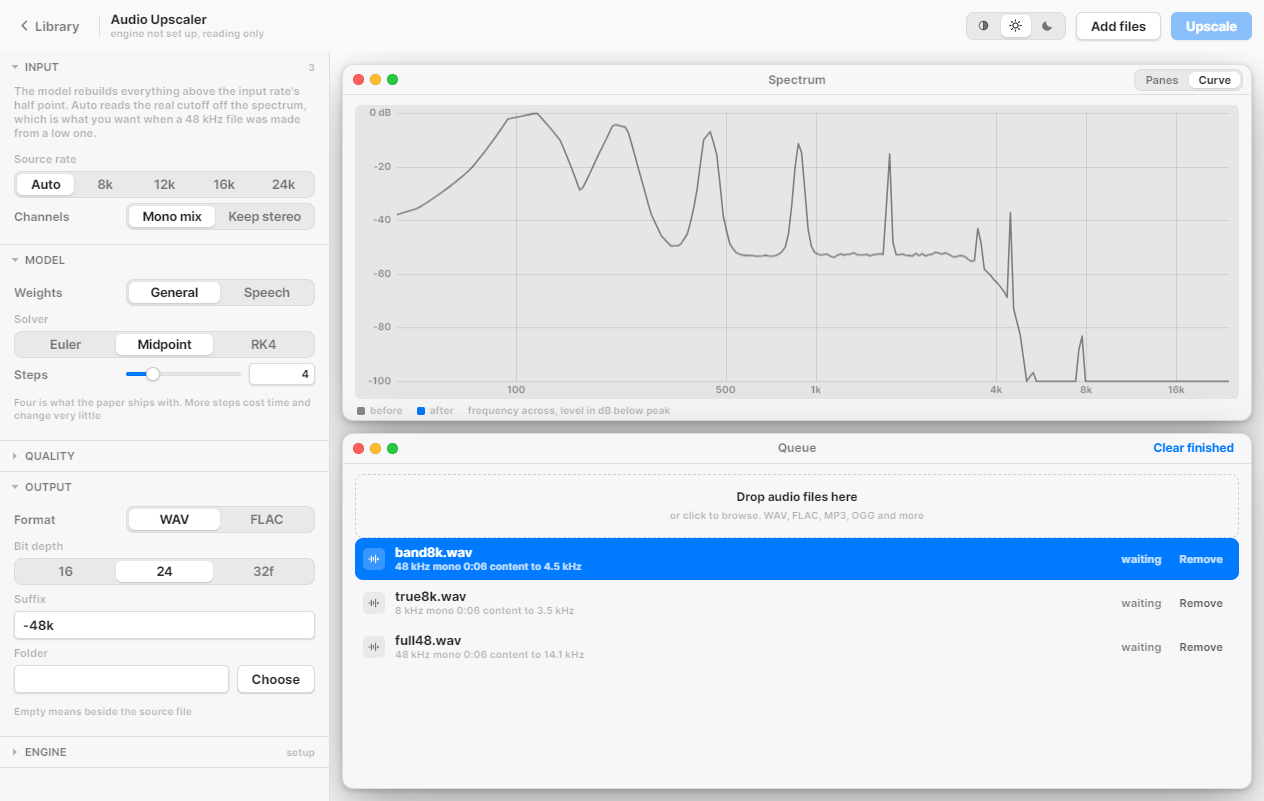
The model reconstructs up to 48 kHz and no further. That is fixed in how it was built, so no setting can push real detail above it. The output rate can be set to 96 or 192 kHz when a session has to run at one of those, but that is a clean resample of the same 48 kHz result: the right container, not more content. Anything claiming otherwise is interpolating silence.
Windows, and Python 3.10 or later
The installer is small. On first launch the app opens on a setup panel that says what it needs and how large the download is, and downloads nothing until you press the button.
An NVIDIA card, ideally
PyTorch with CUDA and the weights come to about 2.7 GB. There is a CPU path at about 550 MB that works and is slow. Both are offered at setup.
The model is UniverSR by Woongjib Choi, Sangmin Lee, Hyungseob Lim and Hong-Goo Kang at DSPAI Lab, Yonsei University, accepted at ICASSP 2026 and released under the MIT licence. This app is a front end for it and claims none of that work.